OverEarning.org
Friday, 29 September 2017
آٹھ محرم الحرام کے جلوس: کراچی سمیت مختلف شہروں میں موبائل فون سروس بحال ہونا شروع
کراچی سمیت ملک بھر کے مختلف شہروں میں آٹھویں محرم الحرام
کے موقع پر کئی شہروں میں معطل ہونے والی موبائل فون سروس اب بحال ہونا
شروع ہوگئی ہے۔
کراچی میں نشتر پارک سے برآمد ہونے
والا 8 ویں محرم الحرام کا مرکزی جلوس حسینیہ ایرانیاں پر ختم ہوا جب کہ
جلوس کی گزر گاہوں سے ملحقہ سڑکوں کو کنٹینر رکھ کر بند کیا گیا۔
جلوس
کی گزر گاہ ایم اے جناح روڈ اور صدر کا علاقہ ہے جہاں دس محرم کی رات تک
دکانیں اور سڑک بند رہے گی جب کہ جلوس کی گزرگاہوں کو 9 سیکٹر اور 23 سب
سیکٹر میں تقسیم کیا گیا ہے۔شہر بھر میں موٹر سائیکل کی ڈبل سواری پر بھی پابندی ہے۔
لاہور:
لاہور
میں 8 محرم الحرام کا مرکزی جلوس امام بارگاہ دربار حسین موری گیٹ سے
برآمد ہوا جو لوہاری، انار کلی اور مال روڈ سے ہوتا ہوا پام اسٹریٹ انار
کلی پہنچے گا۔
یوم عاشور پر پنجاب حکومت نے جلوس کے روٹ پر
فوج اور رینجرز سے مدد طلب کر لی ہے جب کہ ٹریفک پولیس نے بھی نویں اور
دسویں محرم الحرام کے لیے ٹریفک پلان جاری کر دیا ہے۔
پلان کے مطابق
شاہدرہ سے آنے والی ٹریفک براستہ آزادی فلائی اوور ریلوے اسٹیشن آ سکے
گی۔ سگیاں پل اور ائرپورٹ کی طرف رنگ روڈ کھلی رہے گی۔فیروز پور روڈ سے آنے والی ٹریفک پی ایم جی چوک سے سگیاں پل جا سکے گی۔ سرکلر روڈ سے ٹریفک موری گیٹ کے راستے نیلا گنبد جائے گی۔
لاء کالج پنجاب یونیورسٹی سے اردو بازار کی طرف ٹریفک بند رہے گی جبکہ مستی گیٹ سے چوک ٹیکسالی تک بھی ٹریفک بند رہے گی۔ لوئرمال پر ضلع کچہری سے داتا دربارتک ملحقہ سڑکوں سے ٹریفک کا داخلہ بند ہوگا۔
موبائل فون سروس معطل
کراچی، حیدرآباد، سکھر، شکارپور، کشمور، خیرپور اور جیکب آباد سمیت مختلف شہروں میں موبائل فون سروس بحال ہونا شروع ہوگئی ہے۔
پشاور
پشاور
میں آٹھویں محرم کے دو ماتمی جلوس برآمد ہو رہے ہیں، پہلا جلوس امام
بارگاہ نجف علی شاہ کوچی بازار سے تین بجے کے بعد برآمد ہوگا جبکہ دوسرا
ماتمی جلوس بچوں کا ہے جو رات آٹھ بجے امام بارگاہ امام حسین محلہ مرویحا
سے برآمد ہوگا۔
پولیس حکام کے مطابق سیکیورٹی خدشات کی بناء
پر اندرون شہر سیل ہے اور خاردار تاریں لگا کر راستے بند کردیئے گئے ہیں
جب کہ شہر کے تجارتی مراکز اور تعلیمی ادارے بھی آج سے بند ہیں۔
پولیس کے علاوہ پاک فوج اور ایف سی اہلکار بھی تعینات ہیں جبکہ خفیہ کیمروں سے جلوسوں کی نگرانی کی جارہی ہے۔
ضلعی انتظامیہ نے تین روز کے لئے شہر میں موٹرسائیکل کی ڈبل سواری پر بھی پابندی عائد کردی ہے۔
کوئٹہ
محکمہ
داخلہ بلوچستان نے عاشورہ محرم پر موبائل سروس کی بندش کے لئے وفاقی
وزرات داخلہ کو مراسلہ ارسال کردیا، اجازت ملنے کے بعد 9 اور 10 محرم کو
صوبے کے 4 اضلاع میں موبائل فون اور انٹرنیٹ سروس بند رکھی جائے گی۔
صوبائی
محکمہ داخلہ نے نویں محرم کو ضلع بولان کے علاقے مچھ اور دسویں محرم
الحرام کو کوئٹہ، جعفرآباد اور جھل مگسی میں موبائل فون اور انٹرنیٹ سروس
بند رکھنے کی اجازت مانگی ہے۔
فیصل آباد، سرکاری سکول میں ہیڈ ماسٹر کی خاتون ٹیچر سے دست درازی کی کوشش
فیصل آباد(سپیشل رپورٹر) مخلوط تعلیم والے گورنمنٹ پرائمری سکول مصطفی آباد جڑانوالہ میں دوران تدریس ہی ہیڈ ماسٹر نے اپنی ماتحت ایک خاتون ٹیچر کو ایک کمرے میں گھیر کر دست درازی کی کوشش کی جس کی چیخ و پکار پر سکول کے چند مرد ٹیچرز نے فوری طور پر پہنچ کر خاتون ٹیچر کو بچا لیاِِ، شکایت ملنے پر چیف ایگزیکٹو سکولز فیصل آباد مظفر جاوید اقبال چشتی نے انکوائری کے بعد ہیڈ ماسٹر کو جبری ریٹائرکر دیا جبکہ ڈی ای او ایلمنٹری نے اس خاتون ٹیچر کو بچانے والے ٹیچرز کو سزا دیتے ہوئے پانچ پانچ سال کیلئے ان کی انکریمنٹ روک دیں۔ اس کی اطلاع چیف ایگزیکٹو کو دی گئی جنہوں نے ذرائع کے مطابق ڈی ای او ایلمینٹری کو سزا پر نظرثانی کرنے کیلئے لیٹربھیج دیا۔ جب متعلقہ ڈی ای او سے پوچھا گیا تو انہوں نے اس واقعہ کو ایک معمولی واقعہ قرار دیتے ہوئے کہا کہ میڈیا خوامخواہ ہمارے پیچھے پڑ گیا ہے اس طرح کے واقعات تو اس محکمہ میں ہوتے رہتے ہیں تاہم اس واقعہ کو ابھی تک خفیہ رکھا جا رہا ہے اور متاثرہ خاتون ٹیچر کو بھی تسلی دی جا رہی ہے ۔معلوم ہواہے کہ اس واقعہ میں ایک اعلیٰ حکومتی عہدیدار کے پی اے کی طرف سے مداخلت کرتے ہوئے ہیڈ ماسٹر کو بچانے کی کوشش کی جا رہی ہے ۔مصدقہ ذرائع کے مطابق گورنمنٹ پرائمری سکول مصطفی آباد جڑانوالہ میں چند روز قبل سکول کے ہیڈ ماسٹر نے اپنی ماتحت ٹیچر کو ایک خالی کمرے میں اکیلے پا کر اس سے دست درازی شروع کر دی جس پر خاتون ٹیچر نے چیخ و پکار شروع کر دی ،شور سن کر سکول کے چند مرد ٹیچرز فوری طور پر کمرے میں پہنچ گئے اور خاتون ٹیچر کو ہیڈ ماسٹر کے چنگل سے نجات دلائی اوراس کو لعن طعن کی۔ اس واقعہ کے خلاف خاتون ٹیچر نے چیف ایگزیکٹو ایجوکیشن سکولز فیصل آباد کو تحریری درخواست دی جنہوں نے سابق ڈی ای او ایلمینٹری مظفر وڑائچ کو تحقیقات کرنے کا حکم دیا جنہوں نے ہیڈ ماسٹر کو قصور وار قرار دیا جس کے بعد ہیڈ ماسٹر کو معطل کر دیاگیا مگر ٹیچر نے اس سزا کو ناکافی قرار دیا جس کے بعد ایک بار پھر باقی ٹیچرز کے بیانات لئے گئے جس کے بعد اس ہیڈ ماسٹر کو جبری ریٹائر کر دیا گیا۔ اسی دوران ڈی ای اومظفر وڑائچ کا تبادلہ ہو گیا اور ان کی جگہ ڈی ای او ایلمینٹری انور پنسوتہ نے چارج سنبھال لیا اوران تمام ٹیچرز کی سالانہ ترقیاں پانچ پانچ سال کے لئے روک لیں جنہوں نے خاتون ٹیچر کوبچایا تھا۔ اطلاع ملتے ہی ان ٹیچرز نے اعلی حکام کو صورتحال سے آگاہ کر دیا جس پر معاملہ کو نظر ثانی کیلئے دوبارہ ڈی ای او انور پنسوتہ کے پاس بھیج دیا گیا۔ اس سلسلے میں ’’پاکستان ‘‘نے جب ڈی ای او سے رابطہ کیا اور ان سے حقائق جاننے کی کوشش کی تو انہیں سخت ناگوار گزرا اور میڈیا پر الزام تراشی کرنے لگے اوراسے ایک معمولی واقعہ قرار دیا ،ٹیچرز کی سزائیں ابھی زیر التوا بتائی جاتی ہیِں۔
یوم عاشورہ کے موقع پرراولپنڈی ،اسلام آبادمیٹروبس سروس بندرہے گی
یوم عاشورہ کے موقع پرراولپنڈی ،اسلام آبادمیٹروبس سروس بندرہے گی ۔
Friday, 22 September 2017
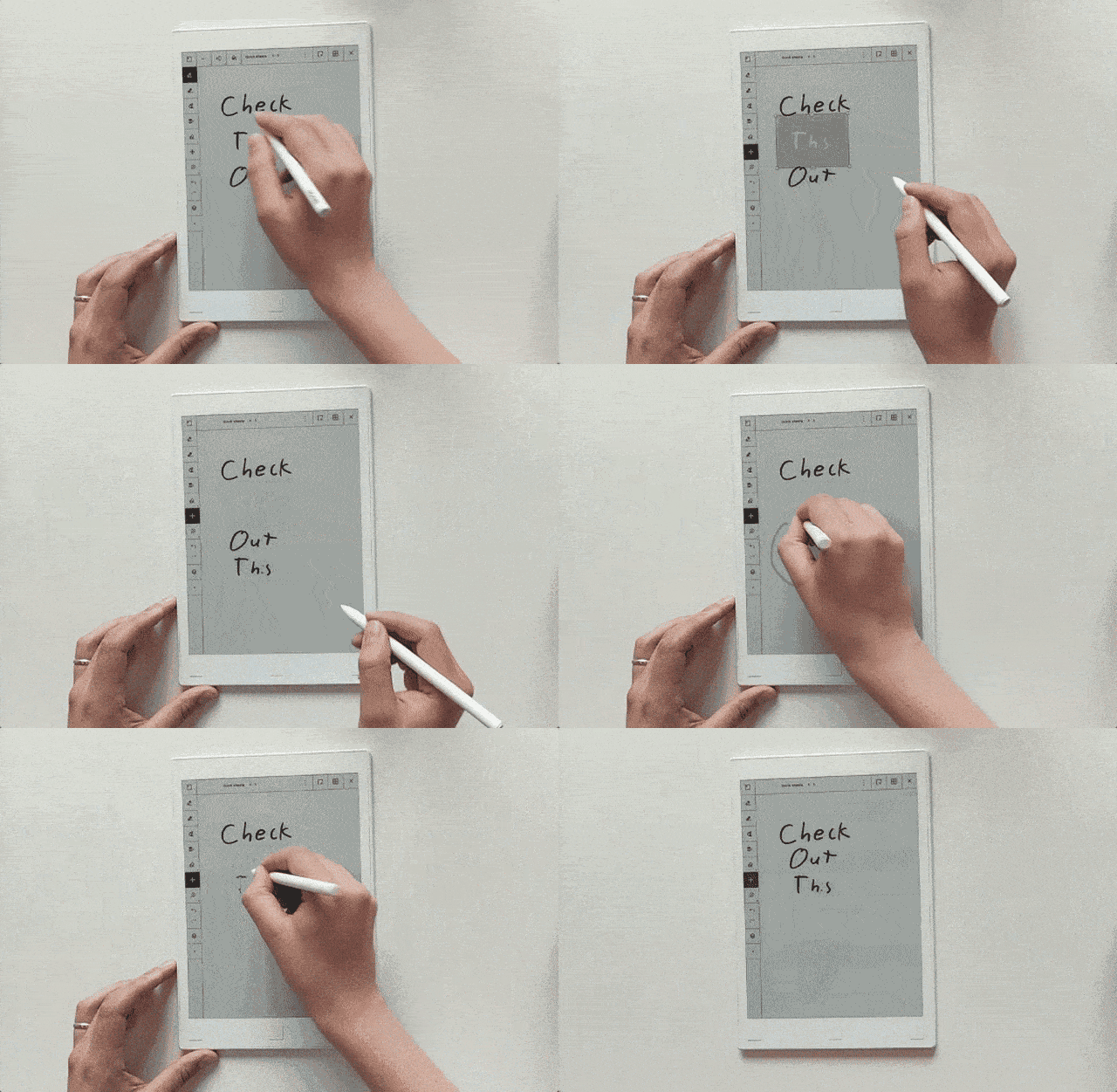
Remarkable E-ink Writing Slate Reviews – Great Tablet, But Not Ready for Prime Time
If that early buzz for the $600 Remarkable tablet had you wishing that you had gotten in on the early pre-orders, I have good news for you:
It's not ready yet.
A handful of reviews were posted on Friday, and they show reveal that the Remarkable still has a way to go in the software department (this could explain why it missed the official mid-August shipdate).
This writing slate measures 10.1" by 6.9" by 0.36" thin, and according to official specs it weighs about 12 ounces. runs a proprietary Linux OS on a 1GHz CPU with 512MB RAM and 8GB of internal storage (there is no card slot).
It has a 10.3" Carta E-ink display (1872 x 1404 resolution - 226 PPI). The Remarkable doesn't have a frontlight, but it does have a capacitive touchscreen and a Wacom stylus that supports 2,048 levels of pressure sensitivity and 512 degrees of tilt detection.
Aside from the screen and the stylus, those specs sound like what you can find on a $100 to $200 ereader, and you can also find cheaper ereaders that are almost s good as the Remarkable (like the Onyx Boox M96, which costs $430, runs Android with a 9,7" E-ink screen, and has both dual-touchscreens).
Is the remarkable worth the extra $170 for an ereader cum writing slate?
Based on the following reviews, I would say yes - once the software is done.
At £529 just for the tablet, with the pen sold separately, this is a seriously expensive device. It’s fantastic at what it does, and the crowdfunding campaign that got it off the ground has been a resounding success, but prioritising the writing experience above all else has forced some compromises.
With no backlight or frontlight, a Kindle is still probably your best bet if you're mainly after an eBook reader. Digital artists that aren’t interested in working purely in greyscale will be better served by an iPad Pro or Microsoft Surface, even if their respective styli can’t match ReMarkable for convincing feel.
I was excited about the potential of the reMarkable tablet, but unfortunately, it didn't quite meet my expectations.
That said, I still think it's an incredible product. The instantaneous nature of the ink is truly impressive, and every person I showed it to was blown away. The prospect of being able to take handwritten notes but save them digitally — not to mention sync them to your computer — is thrilling for those who prefer notepads over notepad apps.
But in making the quickest writing and drawing experience it could, I felt like reMarkable sacrified quickness on the other end. The device's tendency to burn-in was a real problem, as was the slowness to turn the page or navigate back to the home screen. The tablet's user interface still needs work to make it more intuitive, and the overall design could look slightly more modern. In its current form, paying $600 for an E Ink tablet like this in 2017 still seems too steep to me.
Even the best paper notebook needs a good pen—or in this case, a good stylus, to be worth using. The reMarkable comes with a Wacom stylus that works impressively well on the e-ink display, with hardly any latency. It’s tilt and pressure sensitive for better accuracy, but the results can be shaky, so don’t count on it replacing your sketchbook just yet. Those kinks aside, palm rejection works great, and the stylus doesn’t have a battery, so no need to awkwardly plug it into the bottom of your tablet.
When you’re done jotting down ideas for your screenplay or doodling away, you can bounce over to your eBooks tab and dive into The Jungle or Crash Override. Unfortunately, you won’t get as good a reading experience as you’d find on a Kindle due to a few shortcomings.
I found that text doesn’t look as crisp (limited font options don’t help things, either) and then there’s no bookstore so getting your digital library onto the reMarkable is a hassle. If those issues don’t bother you, there are some nice perks like a larger screen and the ability to write notes into a book’s margins, which you can’t do with a Kindle.
The reMarkable's amazing writing experience is a one-of-a-kind feature that when combined with its cloud-sync capabilities and Photoshop-esque editing, makes it a great tool for note takers and artists alike. Writing on the slate is one of the most realistic, comfortable experiences I've had on a tablet, rivaled only by using an actual pen and paper.
Of course, $599 may be a tough price to swallow for some, especially when the device is made just for writing, drawing and reading. For a more feature-rich tablet, consider the $649 10.5-inch iPad Pro, which supports Apple's $99 Pencil stylus. It's $149 more expensive, though, and writing on its glass doesn't feel as natural. However, the iPad has Apple's huge library of apps and games, while reMarkable has a much more limited offering. Still, the reMarkable has to be used to be truly believed, as writers and artists looking for the best marriage of digital and analogue won't find a better option.
The drawing is great, but navigating the tablet's interface is less so. You'll basically have to memorize the meanings of it icon-labeled on-screen buttons. I still routinely do things like delete an entire page of notes when I meant to select the eraser (undo to the rescue), or create a new page when I mean to navigate to anther digital notebook. I also found myself wanting to touch the on-screen buttons with my finger, as not to move the stylus away from what I was writing, and, frustratingly, this does work but only about 50 percent of the time.
In terms of ereading features, the reMarkable is very basic. It supports PDF and DRM-free ePub files, but the software is still a work-in-progress so that makes it hard to review at this point. They plan on adding more features over time; I’ll update this review to reflect any changes as they get added.
At present there’s no table of contents, no dictionary, no bookmarks, no search, no active hyperlinks, no back button, no annotations list, no pinch-zooming, no finger-swipe page turning.
What it does offer is a jump to page option and you can view a list of thumbnails to move around parts of a book.
There are a couple of different ways to zoom in. It has a cropping option that works quite well, and there’s a zoom dial to zoom in and out in increments. Zooming resets with each page turn but cropping remains.
You can add notes and highlights with the stylus, of course, but there is no list to view them or way to add bookmarks so it makes it kind of a hassle to find them unless you remember the page number they were on or manually scan through thumbnail view.
The pen’s stellar performance stands in contrast to the rest of the experience, unfortunately.
The ReMarkable tablet suffers from the telltale limitations of E Ink technology: Tapping on a menu key or scroll wheel basically guarantees a delay and screen flashes while the tablet refreshes. It doesn’t come close to the responsiveness of the stylus, and it’s incredibly frustrating.
The ReMarkable tablet’s battery life is a little better than its performance, but it didn’t last as long as I’d like. After a typical 9-to-5 day of jotting down reminders, organizing my to-do list, and absent-mindedly doodling, I could count on the 3,000mAh battery dipping well below 40 percent by midweek.
ReMarkable’s engineers say they’re targeting two weeks of standby time, which seems a little optimistic. But we’ll have to take their word for it.
How to Visualize Your Data With Grafana [Q+A]
Need to build an application around your data? Learn more about dataflow programming for rapid development and greater creativity.
Welcome to another post in our series of interview blogs for the upcoming Percona Live Europe 2017 in Dublin. This series highlights a number of talks that will be at the conference and gives a short preview of what attendees can expect to learn from the presenter.
This blog post is with Daniel Lee, a software developer at Grafana. His tutorial is Visualize Your Data With Grafana. This presentation teaches you how to create dashboards and graphs in Grafana and how to use them to gain insight into the behavior of your systems. In our conversation, we discussed how data visualization could benefit your database environment.
Percona: How did you get into database technology? What do you love about it?
Daniel: I'm a developer and my first job was working on a transport logistics system, which was mostly composed of Stored Procedures in SQL Server 2000. Today, I would not build a system with all the logic in Stored Procedures — but that database knowledge is the foundation that I built everything else on. Databases and their data flows will always be the core of most interesting systems. More recently, I have switched from Windows to working with MariaDB on Linux. Grafana Labs uses Percona Server for MySQL for most of our internal applications (worldPing and Hosted Grafana). Working with Grafana also means working with time series databases like Graphite, which is also very interesting.
I enjoy working with data as it is one of the ways to learn how users use a system. Design decisions are theories until you have data to either back them up or disprove them.
Percona: Your presenting a session called "Visualize Your Data With Grafana." How does monitoring make DBAs' lives easier and how do graphs make this information easier to apply for DBAs?
Daniel: Good monitoring provides top-level metrics (i.e. throughput, number of errors, performance) for alerting, and other lower-level metrics to allow you to dig into the details and quickly diagnose and resolve an outage. Monitoring also helps you find any constraints (for example, finding bottlenecks for query performance: CPU, row locks, disk, buffer pool size, etc.). Performance monitoring allows you to see trends and lets you know when it is time to scale out or purchase more hardware.
Monitoring can also be used to communicate with business people. It is a way of translating lots of different system metrics into a measurable user experience. Visualizing your data with graphs is a very good way to communicate that information, both within your team and with your business stakeholders. Building dashboards with the metrics that are important to you rather than just the standard checklists (CPU, disk, network, etc.) allows you to measure the user experience for your application and to see long-term trends.
Percona: Why Grafana? What does Grafana do better than other monitoring solutions?
Daniel: Grafana is the de facto standard in open source for visualizing time series data. It comes with tons of different ways to visualize your data (graphs, heat maps, gauges). Each data source comes with its own custom query editor that simplifies writing complex queries, and it is easy to create dynamic dashboards that look great on a TV.
Being open source, it can be connected to any data source/database, which makes it easy to unify different data sources in the same dashboard (for example, Prometheus or Graphite data combined with MySQL data). This also means your data is not subject to vendor lock-in like it is in other solutions. Grafana has a large and very active community that creates plugins and dashboards that extend Grafana into lots of niches, as well as providing ways to quickly get started with whatever you want to monitor.
Percona: What do you want attendees to take away from your session? Why should they attend?
Daniel: I want them to know that you can make the invisible visible, with that knowledge start to make better decisions based on data. I hope that my session helps someone take the first step to being more proactive in their monitoring by showing them what can be done with Grafana and other tools in the monitoring space.
In my session, I will give an overview of monitoring and metrics, followed by an intro to Grafana. I plan to show how to monitor MySQL and finish off with a quick look at the new MySQL data source for Grafana.
Percona: What are you most looking forward to at Percona Live Europe 2017?
Daniel: Firstly, it is always great to have an excuse to visit Ireland (I'm an Irishman living in Sweden). I'm also looking forward to getting feedback from the community on Grafana's new MySQL data source plugin, as well as just talking to people and hearing about their experiences with database monitoring.
Check out the Exaptive data application Studio. Technology agnostic. No glue code. Use what you know and rely on the community for what you don't. Try the community version.
How to publish your own ebook
The internet has transformed just about every industry out there—including publishing. Anyone with a web connection can now post their thoughts for the world to see. And if you have literary aspirations, you can publish digital books on your own terms, rather than waiting for a nod from a publishing house or agent. In this guide, we'll show you the ropes of putting out your own ebooks.
If you're looking for help creating convincing characters, bleeding words onto the page, and editing your work, then you'll need a different set of instructions: We're not going to cover the whole process of writing a book from scratch. Instead, let's assume you've already written your masterpiece and put it in a digital text-based format like Microsoft Word. Once you've reached that point, here are the next steps you need to take to send your literary baby out into the world.
Your first step is to decide where you want your ebook to live. If you just want to share your brainchild with family and friends, you might opt for a simple file-sharing program. For something more professional, you can choose to publish your ebook on a variety of different platforms, reaching a potential audience of millions. Here are a few of your options.
File sharing: The quickest and easiest way to publish your ebook is to upload it to the web, create a shareable link, and then pass it around to your friends, Twitter followers, book clubs, and so on. Services like Dropbox, Google Drive, iCloud, and OneDrive all let you share files for free online. This isn't the most sophisticated publishing option out there: Readers will have to manually load the document onto their e-readers, and it won't show up in any ebook stores. On the bright side, you can get your book live in five minutes—and you won't even have to reformat your manuscript. If, however, you yearn for a more official product, then consider using this method to build up some early buzz about your work, or maybe to offer a preview chapter.
Kindle Direct Publishing: One of the most far-reaching and easy-to-navigate platforms is Kindle Direct Publishing from Amazon. The retail behemoth has sold millions of Kindles over the years, so you're guaranteed the opportunity to reach a wide audience on its platform. This free service is also relatively generous: You can set your own price for your ebook, and depending on what that price is, you keep up to 70 percent of what it brings in. We have more information on how this pricing works below.
Kobo Writing Life: Kobo's e-readers aren't as well known as Amazon's, but like the larger company, Kobo has its own ebook publishing platform, Kobo Writing Life. Again, the publishing process is simple and free, and your royalties can be as high as 70 percent, varying with the book's cost.
Smashwords: To go live on several ebook stores at once, including Kobo, consider Smashwords. This platform gives you 80 percent of the royalties from its own store, and 60 percent of the money your ebook earns from other stores. Like the other options, Smashwords is free and easy to use. The only downside is that books published on this platform won't be available on Amazon.
In terms of mechanics, these three publishing platforms are all very similar. If you have trouble deciding, then start with Amazon, where your potential audience will be bigger. That's the platform we'll focus on in the rest of this guide.
We won't take you through the self-publishing process for every platform. Instead, we'll show you how it works if you sign up with Kindle Direct Publishing. Of course, you can always upload your ebook to several platforms, but Amazon will offer you a few perks if you stay exclusively on the Kindle, like extra promotion for your book and inclusion in the Kindle Owners' Lending Library.
Amazon's process for self-publishing ebooks is refreshingly polished and straightforward. To begin with, you must make sure to put your document in a digital file and to format it properly. The Kindle Direct Publishing system can recognize simple formatting like bold and italic text and paragraph indentations. But don't push it too far—avoid using special fonts or headers and footers. Hit the Enter key to indicate new paragraphs, and use page breaks to indicate the ends of chapters. Amazon provides a full help page on the formatting guidelines you need to follow.
While you're formatting your work, take the time to proofread it as well. If you want your would-be audience to take you seriously and buy your work, your text must be free from weird formatting, spelling mistakes, and bad grammar.
Next, you need to put your literary creation into the Microsoft Word format, with a .doc or .docx extension. Most applications, including Google Docs and Apple Pages, can export in Word format. In Docs, choose File and Download as; in Pages, select File and Export to.
Once you've formatted your file and given it the proper extension, it's ready to upload to Amazon's servers. To do that, start by signing into your Amazon account, or creating an account if you don't already have one. Next, head to your Bookshelf page. The site will ask you for some details about your book, such as a title (obviously), a category, some keywords, and a brief description. Don't rush through this part: The information you enter now is what will attract readers to your ebook. At the moment, the Kindle Store shows that more than 100,000 new ebooks became available in the last month, so you're up against a lot of competition.
Speaking of attracting readers, your book also needs a cover. A beautiful, striking image will make a big difference in setting your ebook apart from the pack, so, depending how artistic you are, you might consider hiring a professional to create original cover art for you. A quick web search will turn up plenty of freelance designers, or you can head to a marketplace like Reedsy. Covers must be in JPEG or TIFF format, with an aspect ratio of 1.6:1, and ideally with dimensions of 2,560 by 1,600 pixels.
Filling out this information and then uploading your manuscript to the Kindle Store is so quick and simple that you might be tempted to rush the process. But we can't emphasize enough how important it is to first clean up your copy and then double- and triple-check your work. While you're looking at designers on Reedsy, you can also find editors, publicists, and others who can help your book make the best possible impression.
As you set up your Bookshelf profile and upload your book, Amazon will also ask you for your address and bank details, for when those royalty payments start flooding in, and the price you want to charge for copies of your ebook. The price is completely up to you, but most readers won't risk paying much for an unknown author. If you're just in it for the creative satisfaction, meanwhile, you can give away your work for free.
With Amazon, the royalties vary depending on how your book is priced. If you charge less than $2.99—which first-time self-publishers should probably do—then you will earn a cut of 35 percent. The higher the price, the higher percentage of the profits you'll earn; you can pull in up to 70 percent when your ebook's price is higher. You can find plenty of advice on Kindle pricing strategies online, but keep an eye out for special sales and promotions on price, such as an initial, time-limited $0.99 offer. These deals can help boost interest in your work.
Once you've entered all that information, you upload your manuscript, and you're done—your ebook is published and available on any Kindle device. It really is that simple. And you run into any snags during the digital self-publishing process, Amazon offers a bunch of tutorial videos that can help you out. Of course, actually turning your ebook into a sales success is much harder. You'll need social media buzz and good reviews to make any kind of impact on the digital self-publishing landscape.
If you want to put your book into actual physical form, then you have a couple choices. Amazon owns a service called CreateSpace that will print and bind your book so you can sell paperback copies. CreateSpace will handle all the details for you, like calculating the sales tax and making sure your book has an ISBN so it can be distributed and sold in stores. However, this service is not free: If you're self-publishing, you'll have to pay for your physical copies.
CreateSpace will charge you $0.85 to $2.15 for each copy it prints—the price depends on the number of pages and whether you need color printing. The service also takes a slice of any money your book earns in sales, leaving you with 40 to 80 percent of the profits. The price and royalty options depend on several different factors; CreateSpace provides a full breakdown on its website.
If you'd prefer more guidance, you can work with a more traditional self-publishing house. These agencies usually request minimum print runs in the region of 1,000 copies, though you can find some houses who will go lower. Your options vary hugely depending on how much assistance you want with the process and how much money you're willing to spend. No matter what you decide, you can find plenty of companies willing to help you become a published print author. To begin with, we'd recommend focusing on the much simpler process of digital self-publishing—and then deciding what to do from there.
Subscribe to:
Comments (Atom)
-
Zardari directs Sindh govt to reconsider repealing NAB law After months of controversy, Pakistan Peoples Party (PPP) Co-chairman ...
-
The world of digital marketing is constantly changing, especially when it comes to search engine optimization or SEO. SEO is one of...
-
The PML-N’s digital soldiers In 2014, Umair Talat sent out a few requests in hopes of meeting then-Prime Minister Nawaz Sharif. Th...